
Enterprise Thinking
See the whole business.
Enterprise Thinking begins with the organization’s vision, mission and intended results. It then examines whether the entire organization is structured, connected and managed to achieve those results.
What Is Enterprise Thinking?
Most organizations are divided into departments, functions, management layers and individual budgets. That structure is necessary, but it can also create problems.
A department may achieve its own targets while the organization as a whole fails to achieve its objectives. A cost reduction in one department may create additional costs elsewhere.
Enterprise Thinking looks across those boundaries, at the full business chain. The objective is not merely to make individual departments more efficient. It is to improve the performance of the entire organization.
Don’t just optimize the individual parts. Make the entire organization work.
Why Organizations Underperform
Underperformance is rarely caused by a lack of effort or capable people. It usually develops in the spaces between departments.
Departmental boundaries
Each department optimizes its own part of the work. A department can meet its own targets while the organization as a whole misses its objectives.
Separate budgets
A cost reduction in one budget can create additional costs in another. On paper, money is saved; in reality, it has only moved.
Conflicting priorities
When departments work towards different goals, decisions take longer and problems move from one team to the next without being resolved.
Weak handovers
Work and information pass between teams many times. A process improvement fails when the next department is not ready to receive the output.
Excessive reporting
Every new reporting requirement takes working time away from operational staff. Management information improves while the work itself slows down.
How the Approach Works
A clear sequence that starts with the results the organization wants to deliver and ends by verifying that the improvements deliver them.
Vision and objectives
What is the organization trying to achieve, and which results does it intend to deliver?
Overall business chain
How does the work actually flow from start to finish, across all departments?
Responsibilities and handovers
Who is responsible for what, and what happens where work and information pass from one team to the next?
Resources and risks
Are people, budgets and systems used where they contribute most, and which risks affect the whole chain?
Practical improvements
Which changes improve the whole organization, not just one part? Developed with the people who do the work.
Measurement and verification
Are the changes working in day-to-day practice, and are they delivering the intended results?
The objective is not to produce the most complicated model.
The objective is to make complexity understandable.
What Clients Gain
Every organization is different, so results are never promised in advance. What the approach is designed to bring:
- Better alignment between strategy and operations.
- Clearer responsibilities across departments.
- Less duplication and unnecessary administration.
- Better identification of underlying causes.
- Improved decision-making based on overall business impact.
- More effective implementation and follow-up.
Enterprise Thinking Before Enterprise Transformation
Transformation has become one of the most frequently used words in business.
Digital transformation.Business transformation.Organizational transformation.AI transformation.
But transformation without understanding can become an expensive way of changing the wrong things.
Before transforming an enterprise, we should understand it.
That is the principle behind Enterprise Thinking.
Think first. Understand the whole. Then change what matters.
Start With Your Own Organization
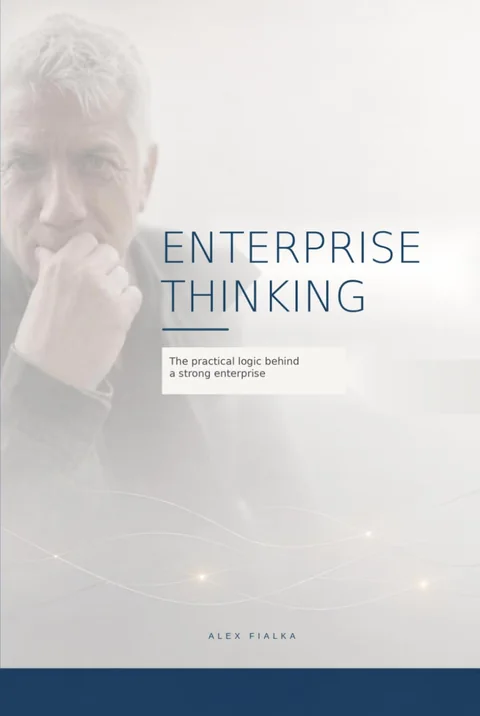
The ideas behind Enterprise Thinking are set out in the book of the same name. The most useful next step, though, is a conversation about your own organization: what it is trying to achieve and what is getting in the way.